Individual bank statement analysis is the review of an applicant's personal bank transactions to confirm salary, find existing debt payments and decide whether a new loan, card or buy-now-pay-later plan is affordable. In the UAE that decision has fixed reference points: the 50% debt burden limit, the cap of 20 times salary on a personal loan, and the income the applicant declared on the form.
This guide covers what a lender needs from a personal statement, how each figure is calculated, which signals deserve a closer look and where the method stops. It includes a worked example in the Individual mode of PaperWork BSA on a synthetic statement, and an honest comparison with other tools that analyse consumer bank data.
Key Takeaways
- Read the salary month by month, not as an average: the employer, the pay day and every month paid or missing.
- Count loans, credit cards and BNPL from the transactions, then replace card payments with a share of the card limit when the limits are known.
- The debt burden ratio is debt payments divided by regular income; UAE lenders work against a 50% limit.
- Check the declared income against the salary actually credited. A net declaration should match within 10%; a gross one may sit above the credit by what deductions explain, which a statement alone cannot confirm.
- In the worked example, a declared net income of AED 25,000 met a credited salary of AED 18,500, and the debt burden rose from 24.3% to 32.8% once the card limits were added.
Individual bank statement analysis on a sample statement
The recording uses a synthetic Wio statement for a fictional Dubai employee, Omar Faisal Rahman, covering March to August 2026. It shows the upload in Individual mode, the summary, the declared income and card limits, a payment check, a signal with its transactions, the salary calendar, the debt payments and the Excel report. Processing time and typing are shortened in the edit.
The figures from the recorded run:
| In the example | AED | Where it comes from |
|---|---|---|
| Regular monthly income | 18,500.00 | WPS salary from Brightpath Logistics LLC, median of 6 months |
| Variable pay not counted | 1,541.67 | A bonus, shown but kept out of regular income |
| Emirates NBD loan | 2,150.00 | Monthly instalment, 6 months paid |
| ADCB credit card | 1,939.37 | Monthly payments seen, 6 months |
| Tabby | 410.00 | BNPL, 3 months paid |
| Debt burden, payments seen | 24.3% | 4,499.37 of 18,500.00 |
| Debt burden, with card limits | 32.8% | Cards at 5% of AED 70,000 in limits: 6,060.00 of 18,500.00 |
| Estimated payment capacity | 1,382.22 | Income after observed spending and debt payments |
| Personal loan ceiling | 370,000.00 | 20 times the monthly income |
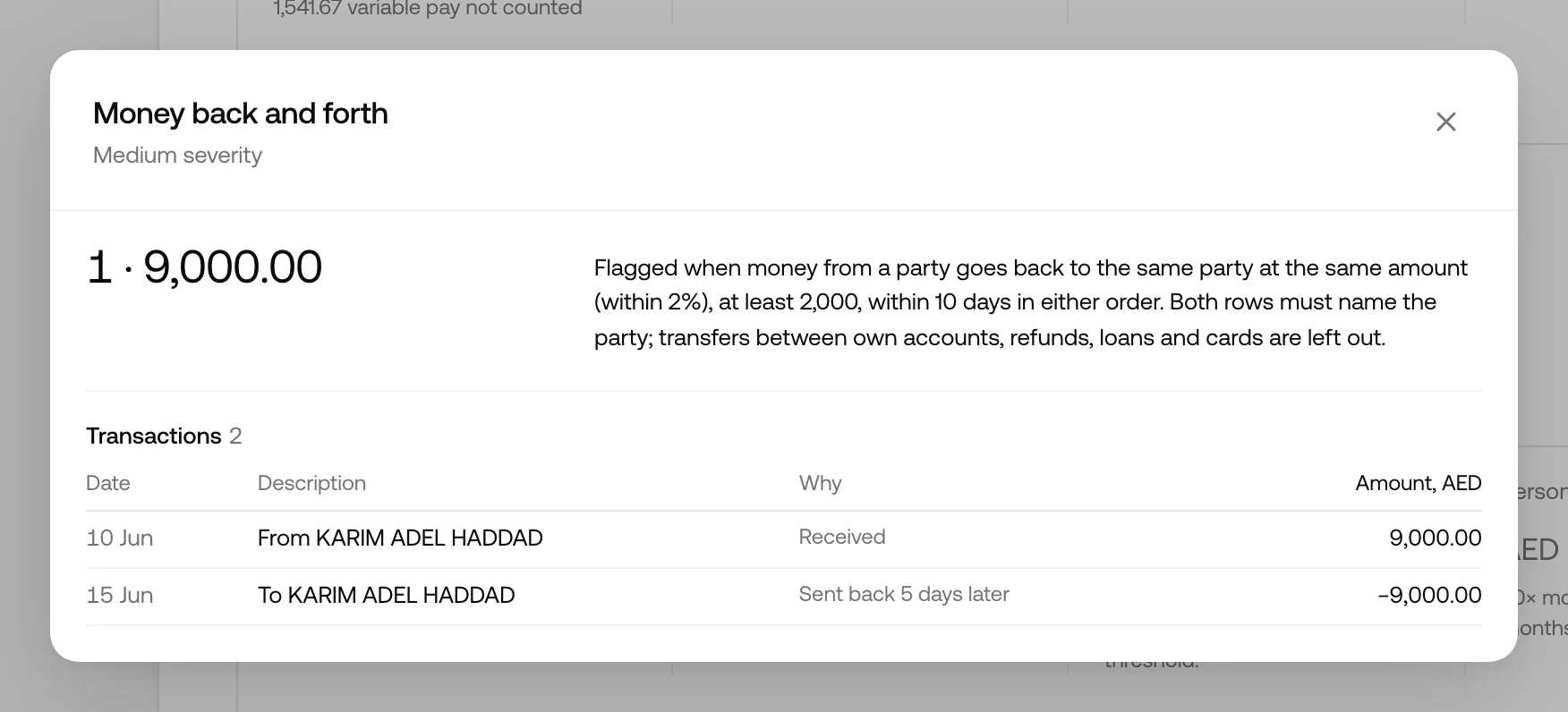
The applicant declared AED 25,000 net. The statement shows 18,500 credited each month, 26% less, so the report flags the gap. It also flags one AED 9,000 transfer received from a private person and sent back to him five days later. The figures come from synthetic data and illustrate the method only.
What lenders look for in a personal bank statement
A lender reads an individual's statement to answer four questions:
- Is there a regular salary? Who pays it, how much, on which day, and whether any month is missing, late or lower.
- What does the applicant already owe? Loan instalments, card payments and BNPL plans, with the monthly amount for each.
- Can the applicant carry one more payment? The debt burden ratio against the limit, and what is left after normal spending.
- Does anything contradict the application? A declared income the salary does not support, money that only passes through, or borrowing taken just before applying.
The rest of this guide takes them in order.
Salary month by month
Find the salary credits first. A WPS credit from an employer is the strongest evidence. A regular monthly transfer from a company that makes up most of the money coming in can also be a salary even when the description does not say so. A salary paid by a private person is different and should be questioned.
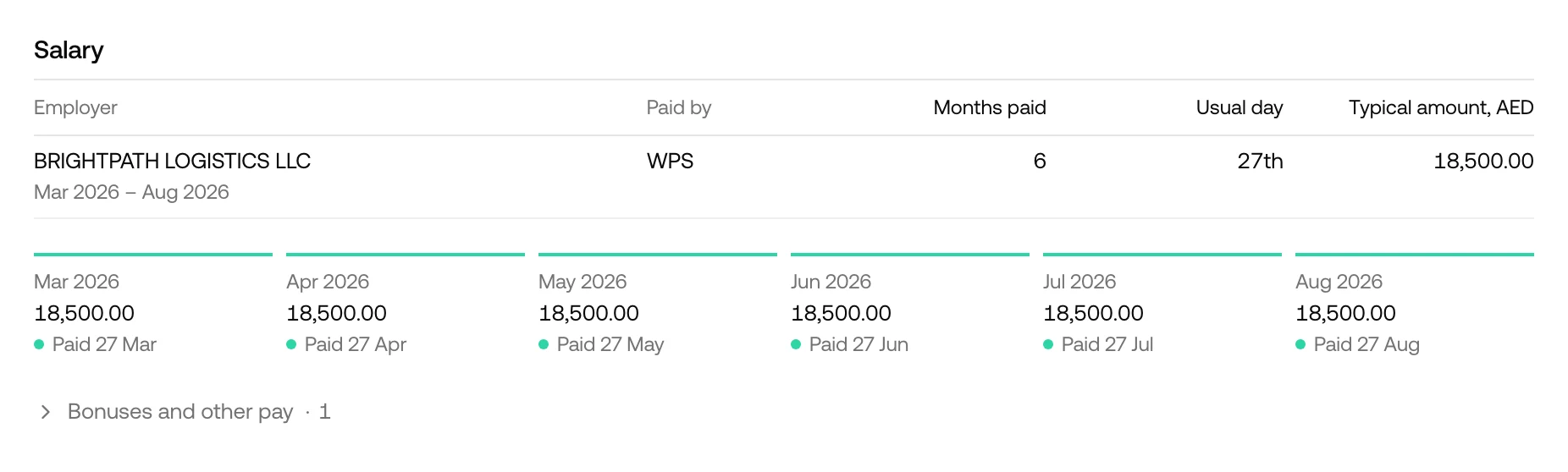
Use the median of recent months as regular income. One high month or a bonus should not raise the figure a loan is sized on, so variable pay is shown separately and left out. Then read the calendar for the exceptions a lender cares about:
- Missing months. A complete month with no salary. Two such months after the last payment mean the salary has stopped.
- Late pay. A salary more than seven days after the usual day.
- A drop. A month paid at less than 80% of the usual amount.
- A new employer. The payer changed within the period.
Debt payments: loans, cards and BNPL
Every recurring payment to a lender is an existing obligation: personal and car loan instalments, credit card payments, and BNPL plans such as Tabby or Tamara. List each lender with the months paid, the last payment and the typical monthly amount.
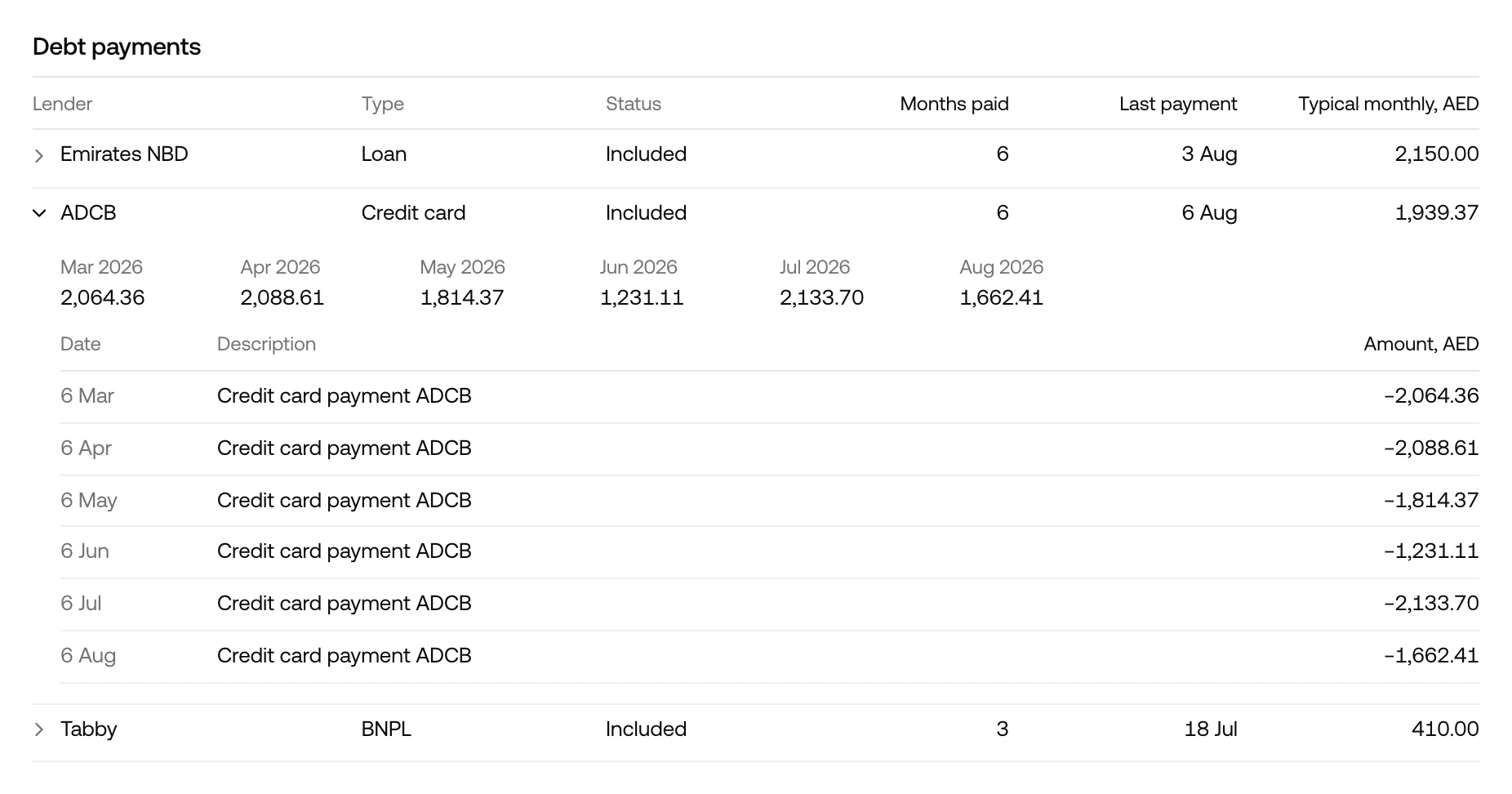
Credit cards need one more step. A card payment seen in the statement depends on how much the applicant chose to repay that month. Lenders in the UAE usually count a card at a share of its limit instead, commonly 5%. Enter each limit from the application or the credit bureau report with the bank that issued the card. A limit replaces the payments seen to cards of that same bank: an ADCB limit replaces the ADCB card payments, and nothing else. If a bank has more cards in the statement than limits given, the limits go to the cards paid least and the others stay at their payments, so a missing limit never lowers the burden. A limit for a card that does not appear in the statements, or without a bank name, is added on top.
Debt burden, payment capacity and the loan ceiling
The debt burden ratio (DBR) is the monthly debt payments divided by regular monthly income. The CBUAE regulations cap instalments at 50% of salary and regular income, and most lenders keep their own policy below that.
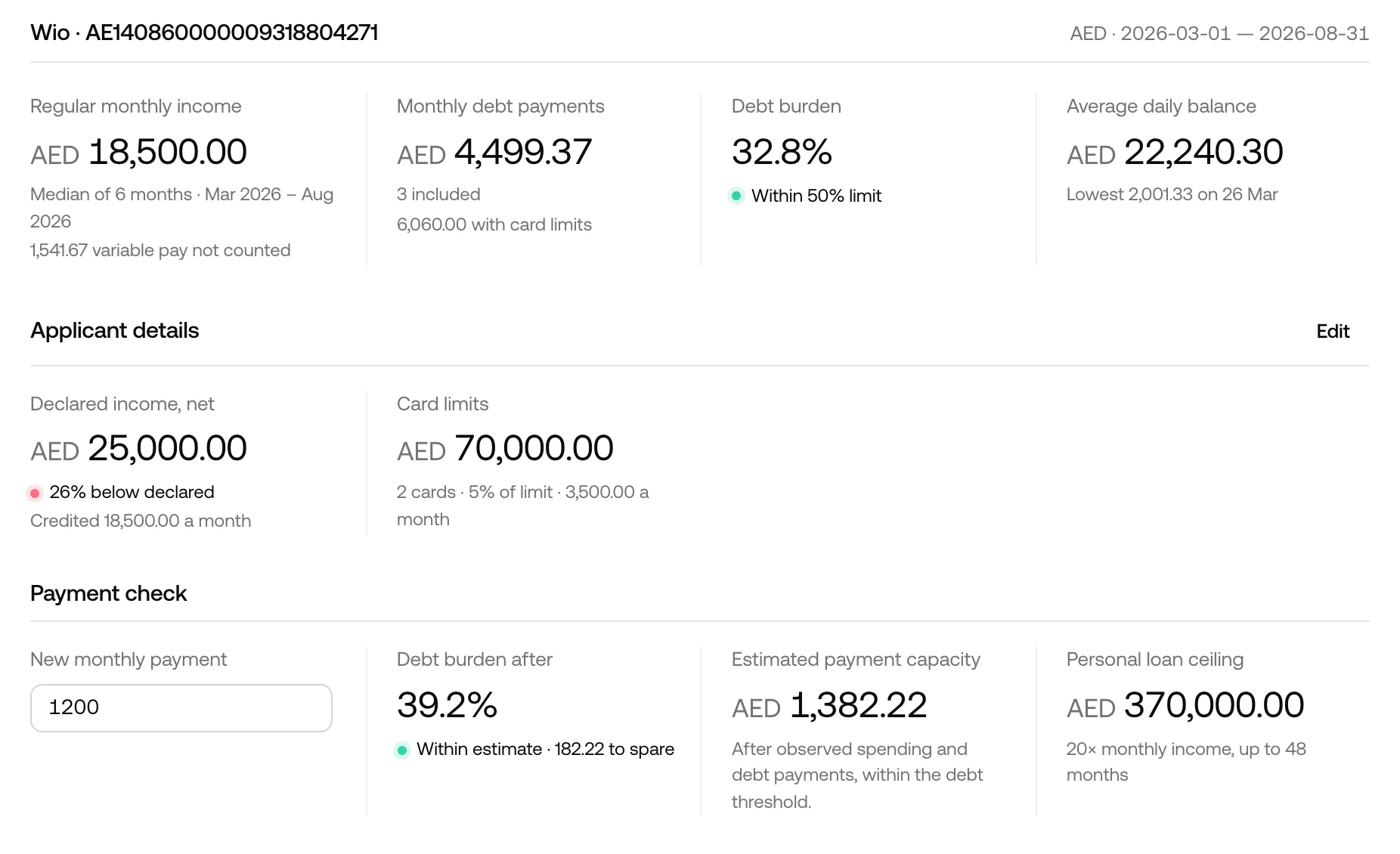
Two limits apply to a new payment, and the lower one wins:
- The debt limit: half of regular income, less the current debt payments.
- The cash left: regular income, less debt payments, less the average monthly spending of the complete months.
In the example, the debt limit leaves AED 3,190 but observed spending leaves only AED 1,382.22, so 1,382.22 is the estimate. A personal loan ceiling of 20 times the monthly income over up to 48 months, the limits set in the same CBUAE regulations, is shown next to it.
The salary in a statement is net of deductions. The CBUAE rule is written on gross salary, so a DBR built on the credited salary is the more conservative of the two.
Declared income against the salary paid
The application states an income; the statement shows what arrived. Enter the declared figure and say whether it is net or gross.
- Net: the credited salary should be within 10% of it. In the example, AED 18,500 against AED 25,000 is 26% short, which is flagged as AED 6,500 a month.
- Gross: a credit within 10% of the declared gross figure counts as consistent. A credit 10% to 25% below it is marked not comparable, because a statement does not show deductions; ask for a salary certificate or payslip. A larger gap is flagged as below declared.
Review signals
PaperWork's Individual report runs 17 checks and lists each with its result. Each one opens into the rule and the transactions behind it.
| Group | Signals |
|---|---|
| Salary | No salary found, salary missing, salary paid late, salary dropped, employer changed, salary from a private person, income below declared |
| Debt | New borrowing in the last 90 days, buy now, pay later in use, payments returned unpaid |
| Money in | Money from other people, large one-off credits, relies on cash deposits, money back and forth |
| Account | Low balance, gambling, short statement history |
A signal is a question for the reviewer, not a decision. A transfer from a relative can be ordinary; the same transfer just before an application, returned a few days later, is worth asking about.
Where this method stops
Be clear about what a statement-based report does not do:
- It is not a credit score. The report gives income, debt payments, affordability and signals. It does not predict default, and the decision stays with your credit policy.
- It reads PDFs the applicant supplies. There is no open-banking connection, so the statement must be genuine. Checking whether a PDF was edited is a separate step, run in document fraud detection.
- It sees only the accounts submitted. A loan paid from another account will not appear. A credit bureau report is the complement for obligations.
- The rules are UAE rules. The 50% limit and the 20 times / 48 months ceiling come from the CBUAE regulations; WPS salary is UAE practice.
How individual statement analysis tools compare
Several vendors analyse consumer bank data. The table summarises what each says on its own public pages as of October 2026. "Not stated" means the pages we read do not say either way, not that the feature is missing.
| Tool | Data source | Salary and income | Debt and affordability |
|---|---|---|---|
| PaperWork BSA, Individual | PDF statements | Salary calendar, WPS, employer, declared income check | Loans, cards, BNPL; DBR against 50%; card limits; 20× ceiling |
| Lean Technologies | Open banking only | Income Insights: salaries, recurring deposits | Debt obligations on a real-estate page; no ratio stated |
| Tarabut | Open banking or direct data input | Salary Check API: amount, frequency, months | Risk flags; affordability not stated |
| Perfios | PDF, scans, internet banking | Salary as a report field | Liabilities as a report field |
| FinBox BankConnect | PDF, net banking, Account Aggregator | Salary from recurring credits | Obligations incl. BNPL; FOIR formula |
| Inscribe | PDF, scans, photos, open-banking data | Income and repayment capacity | Debt obligations mentioned; no ratio |
| Plaid Income | Connected accounts, payroll, documents (bank statements on a custom contract) | Income streams, gross and net, employer from payroll | Not stated |
| Plaid Check, Consumer Report | Connected accounts | Income Insights: gross and net, forecast, employer name | Rent and BNPL in beta |
| Ocrolus | Documents and Plaid data | Income from statements, pay stubs, tax forms | Not stated |
Beyond income and debt:
| Tool | Tampering checks | Credit score | Markets stated |
|---|---|---|---|
| PaperWork BSA, Individual | Separate Fraud Detection tool | No | UAE |
| Lean Technologies | Not stated | Not claimed | UAE, KSA |
| Tarabut | Not stated | Not claimed | Bahrain, KSA; UAE in-principle approval |
| Perfios | ePDF manipulation checks | Not claimed | India, UAE, Singapore and others |
| FinBox BankConnect | 15+ fraud types | A "credit worthy score" in a sample | Not stated; India references |
| Inscribe | Core product, 0-100 trust score | Not claimed | Not stated |
| Plaid Income | Document fraud score on request | Not claimed | US, Canada, UK; payroll US only |
| Plaid Check, Consumer Report | Not stated | LendScore, beta | US only |
| Ocrolus | Detect product | Not claimed | Not stated; US references |
Sources, read on 24 October 2026: Lean financial data, Lean real estate, Tarabut Salary Check API, Tarabut risk flags, Tarabut UAE approval, Perfios BSA, FinBox BankConnect, FinBox FOIR and obligations, FinBox fraud checks, Inscribe bank statement analysis, Plaid Income, Plaid Document Income, Plaid Check, Ocrolus income, Ocrolus consumer lending, Mastercard Open Finance VOI, Fintech Galaxy CreditX.
Where PaperWork differs:
- UAE debt rules built in. None of the pages we read documents a DBR against the 50% limit, card limits counted at a share of the limit, or the 20 times salary ceiling. FinBox describes FOIR, its Indian counterpart.
- A salary calendar. Paid, late or missing for each month, WPS or transfer, and a change of employer. Tarabut returns amount and frequency; Plaid Check returns an employer name, for US consumers only.
- PDFs in the UAE. Lean, Tarabut and Fintech Galaxy work from open-banking consent. PaperWork covers applicants whose bank is not connected and statements already collected.
Where it is weaker:
- No open banking. Lean, Tarabut, Plaid, Finicity, FinBox and Perfios can pull data from the bank directly, which removes the risk of an edited PDF.
- No credit score. Plaid Check offers LendScore in the US, Fintech Galaxy offers CreditX, FinBox shows a score.
- A narrower market. The rules are UAE rules, and coverage is limited to the UAE bank layouts PaperWork has parsers for. Perfios claims more than 1,000 banks.
- Statements only. Ocrolus, Inscribe and Plaid also read pay stubs and tax forms.
FAQ
What is individual bank statement analysis?
It is the review of a person's bank transactions to confirm salary, find existing debt payments, measure affordability and spot risk signals before granting a loan, card or BNPL plan.
How is the debt burden ratio calculated from a bank statement?
Add up the monthly debt payments, counting cards at a share of their limit when the limits are known, and divide by regular monthly income. In the UAE the result is compared with the 50% limit.
How many months of statements are needed?
Six months is common for personal lending and is what PaperWork uses for regular income. A shorter history is flagged.
Can a statement confirm a declared gross salary?
Only roughly. A statement shows the salary after deductions. A credit within 10% of the declared gross figure counts as consistent; a credit 10% to 25% below it is marked not comparable rather than flagged, and only a larger gap is flagged.
Does PaperWork give a credit score?
No. It reports income, debt payments, affordability and signals with their transactions. Scoring and the decision belong to your credit policy.
Can it detect a fake bank statement?
The Individual report raises behavioural signals such as money sent back and forth. Checking the PDF itself for edits is done by document fraud detection, which runs on the same statements.
Can we use it through the API?
Yes. The applicant report comes from the same job as JSON over the BSA API and in the Excel export.
Try it on your own applicants
Bring a few anonymised applicant files with the declared income and card limits, and compare the report with your current review. Request a demo, see PaperWork BSA, or read how the Business and Individual modes differ. For BNPL rules, see BNPL income verification in the UAE.