The best bank statement analysis software does more than turn a PDF into rows. It has to prove the rows are complete, separate real income from money moving between the applicant's own accounts, and show an underwriter which months and which transactions a number came from. Many small-business funders still do that by hand: 88% of funders and alternative lenders in a 2025 deBanked and MoneyThumb survey said they still review documents manually.
This guide compares 12 tools a lender, bank, BNPL provider or broker can buy today. For each one: what it does with a statement, where it is strong, where it falls short, and what it costs when the vendor publishes a price. Vendor numbers are quoted as the vendor's own claims; we did not benchmark them.
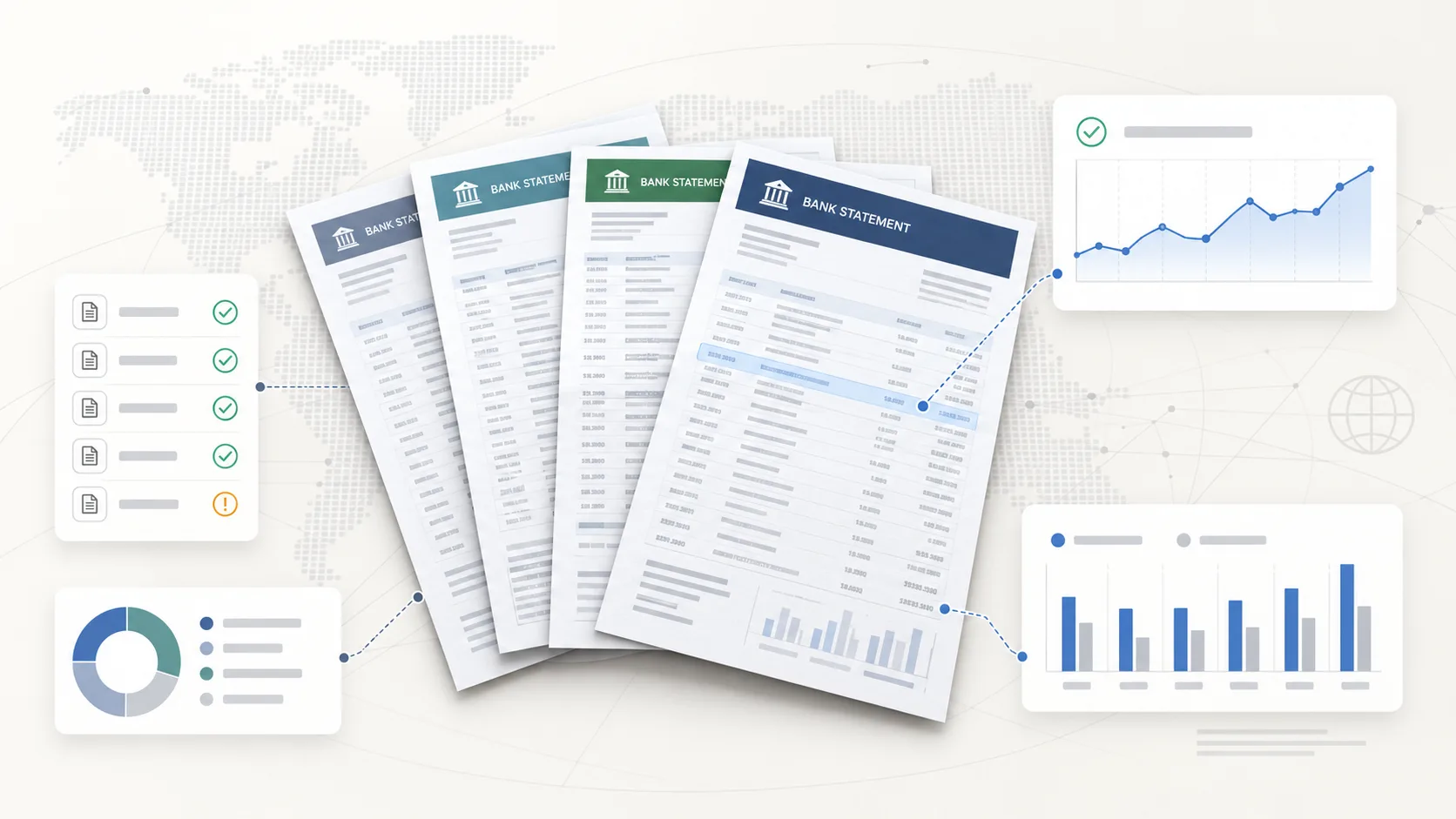
TL;DR
Paperwork is the pick when the numbers have to be defensible: every statement layout has its own parser that checks the running balance on each row, transactions are classified by readable rules, and each of the 50 cash flow metrics says whether it is verified, estimated or unavailable. It runs as a cloud API or on your own servers. Perfios has the widest bank coverage for banks and NBFCs in India and other emerging markets. Ocrolus and Heron Data are built for US small-business funding, MoneyThumb for US funders on a budget, and FinBox for Indian digital lenders. DocuClipper, Docsumo, Nanonets and Doxis AI.dp are extraction tools that leave the underwriting logic to you, and Inscribe and Plaid cover fraud and income verification rather than full analysis.
How we chose
Every tool was assessed on the same six criteria:
- Parsing and reconciliation: does the tool prove that every transaction was read, or does it only extract what it finds?
- Analytics: transaction categories, monthly cash flow metrics and lending risk checks out of the box.
- Fraud signals: whether edited or fabricated statements are flagged, and how.
- Coverage: banks, countries, scanned files and statement languages.
- Output and deployment: API, Excel, an analyst review screen, and whether the platform can run on your own infrastructure.
- Buying friction: published pricing, free trials, and whether a mid-size team can start without a long enterprise sales cycle.
Paperwork is our product. It is listed first because of how it handles the first two criteria, and its limitations are stated as plainly as everyone else's. Bank coverage is the criterion where it is not the leader, and the guide says so.
What bank statement analysis covers
A statement passes through five stages between upload and a credit decision. Most tools on this list do the first stage well; the differences are in the other four.
Stage two is the one buyers skip in demos. A parser that silently drops one row on page four still produces a tidy spreadsheet, and every metric built on it is wrong. Checking the running balance row by row is the cheapest way to know that did not happen. Stage three decides whether revenue is real: transfers from the applicant's other accounts, a director or a sister company look like income unless the tool knows who those parties are. A worked example of separating customer revenue from other credits shows how far the figure can move.
Stage five overlaps with fraud. Bank statements are the document lenders worry about most: in Inscribe's 2026 survey of 90 fraud and risk leaders, 85.6% named them the document type most vulnerable to manipulation. Inscribe sells fraud detection, so treat that as vendor data, but the direction matches what lenders report elsewhere.
The 12 tools at a glance
| Tool | Focus | Best for | Published pricing |
|---|---|---|---|
| Paperwork | Statement analysis with reconciled metrics | Banks, lenders and BNPL providers that need defensible numbers | Free demo; API from $500/month; license and custom quoted |
| Ocrolus | Lending document analytics | US small-business funders and mortgage lenders | Not published |
| Perfios | Bank statement analyser for BFSI | Banks and NBFCs in India and emerging markets | Not published |
| Heron Data | SMB underwriting automation | US MCA, term-loan and SBA funders | Not published |
| MoneyThumb | Statement conversion and underwriting metrics | US funders and brokers on a budget | From $599.95/year |
| FinBox BankConnect | Statement and Account Aggregator data | Indian digital lenders | Not published |
| Inscribe | Document fraud detection | US banks, credit unions and fintechs | Not published; free 4-week pilot |
| Docsumo | Document AI with a bank statement solution | Teams configuring their own workflow | Free 14-day trial; paid plans quoted |
| DocuClipper | Statement to Excel and accounting conversion | Accountants, bookkeepers and small lenders | From $20/month (annual) |
| Nanonets | Document workflow automation | Extraction into ERP and accounting systems | $50 free credits, then from $100/month |
| Doxis AI.dp (formerly Klippa DocHorizon) | Document extraction platform | European teams processing Latin-script statements | EUR 25 free credits; quote-based |
| Plaid Document Income | Income verification from uploaded documents | US, Canadian and UK income checks | Not published |
1. Paperwork
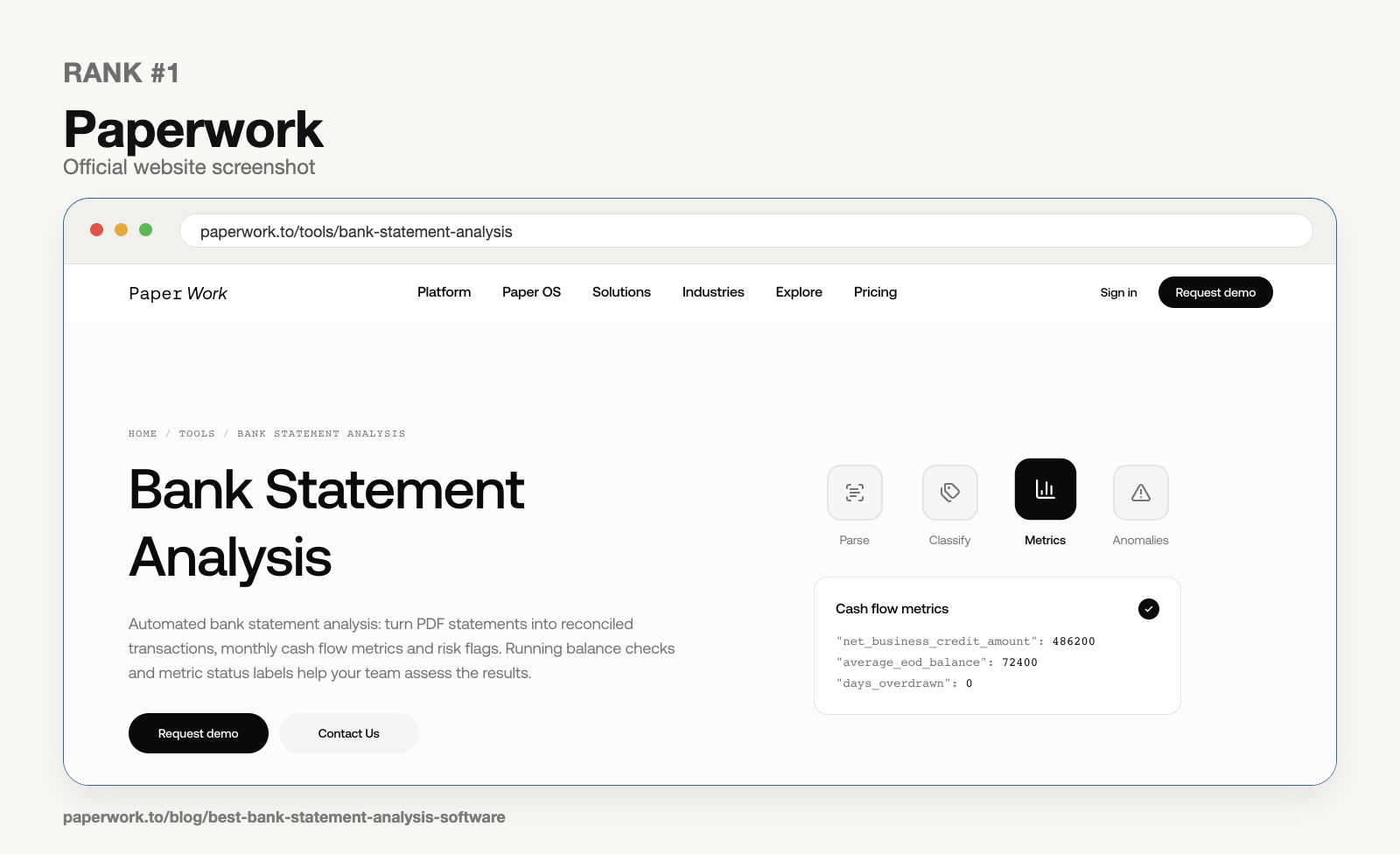
Paperwork is a bank statement analysis API for lenders and banks. It works best for teams that need every metric traced back to transactions and a statement that does not reconcile to be stopped rather than guessed.
What it does
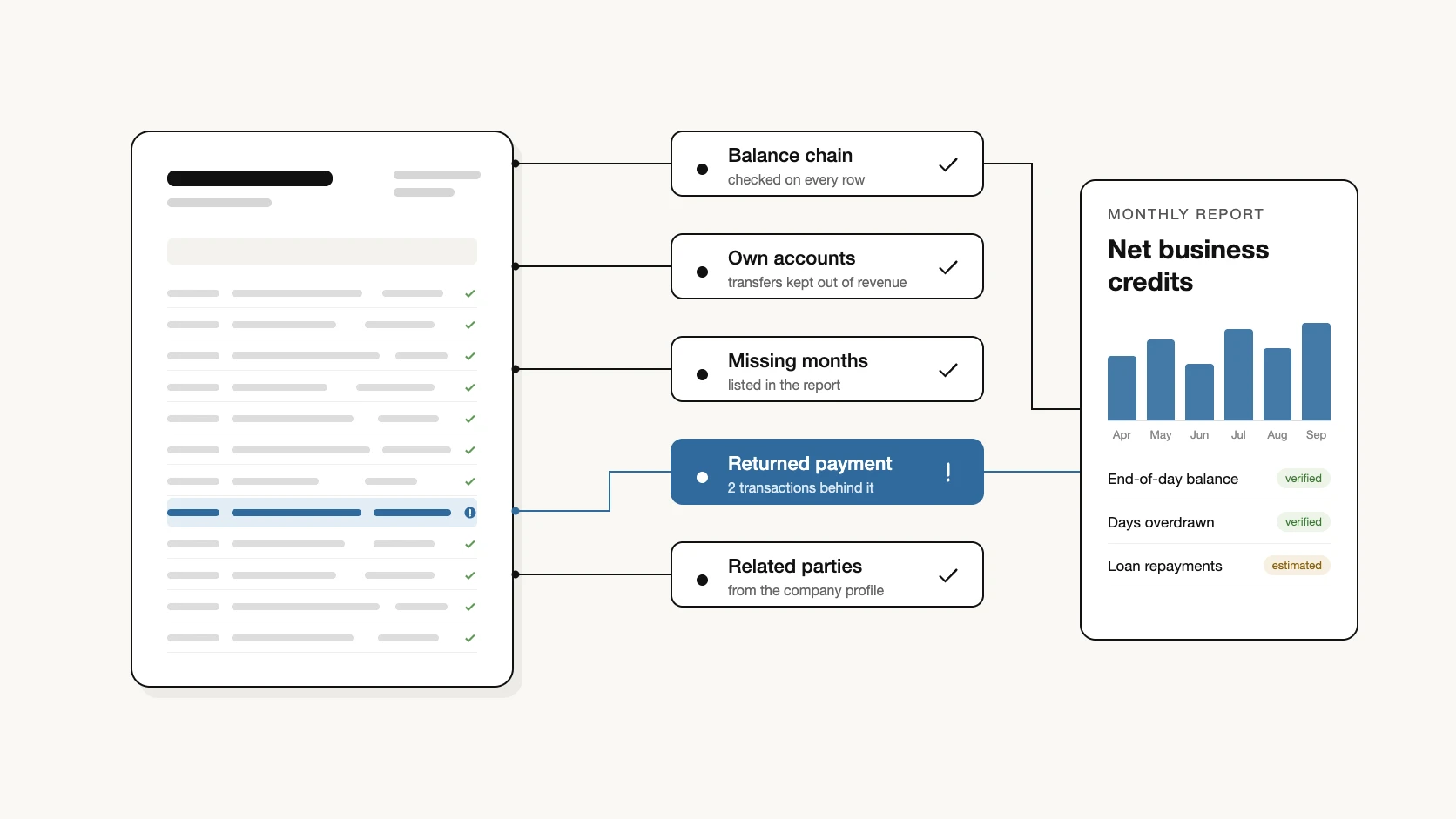
Each supported statement layout has its own parser, and the parser checks the running balance on every row. A statement that does not reconcile is flagged instead of passed on. Native and scanned PDFs are accepted, scanned pages are read with OCR, and if a PDF is locked the job pauses and asks for the password. One job takes up to 50 PDFs, so several accounts and many months can be analysed together; overlapping periods are de-duplicated and missing or partial months are listed in the report.
Transactions are classified by readable rules: salaries, rent, loans, cheque returns, card repayments and more. Add a company profile with the client's own accounts and related people and companies, and transfers between them are kept apart from real revenue. Analysts can work in review mode, confirming unclear classifications and changing transaction types before the numbers are used.
The output is 50 cash flow metrics split by month, from net business credits and end-of-day balances to days overdrawn, loan repayments and cheque returns, plus 12 risk checks such as round-tripping, pass-through money, cash surges, returned payments, large one-off credits and new borrowing, each with the transactions behind it. Every metric carries a status: verified, estimated or unavailable, so an underwriter knows which numbers to rely on. Results come back as JSON over the REST API, as an Excel export, or in the dashboard.
Strengths
- Row-by-row balance reconciliation, so a parsing error shows up as an error and not as a wrong revenue figure.
- Readable classification rules and a review mode, which make every category explainable to a credit committee or an auditor.
- Related-party and own-account handling through a company profile, the main source of inflated revenue in business lending.
- Pairs with Fraud Detection on the same statements, which checks file history, arithmetic and pasted text.
- Deployment range: a cloud API, or a software license to run the platform on your own servers or private cloud.
Limitations
- Coverage is narrower than the largest vendors: 96 statement layouts from 30 banks today, most of them in the UAE, including Emirates NBD, FAB, ADCB, Mashreq, ADIB, Dubai Islamic Bank, RAKBANK and Wio. A layout it has not seen is returned as unsupported, and new layouts are added on request.
- Statements only. There is no open-banking or account aggregator connection, so data comes from the PDFs the applicant provides.
Pricing
A free demo workspace, then API plans from a $500 minimum monthly commitment with usage billed against it. Enterprise volume pricing, software licenses and custom projects are quoted. See the pricing page.
2. Ocrolus
Ocrolus describes itself as an AI workflow and analytics platform for lenders. Its core market is US small-business funding and mortgage lending.
What it does
Ocrolus classifies documents, extracts the data and runs fraud detection for fake documents and data inconsistencies. For small-business funding it adds cash flow analytics with transaction tags, revenue and debt capacity calculations, industry classification and account monitoring. In October 2025 it launched Encore, a double opt-in network for sharing small-business cash flow data between funders; the company says it serves more than 175 funders.
Strengths
- Analytics and fraud detection in one platform, built around US lending documents.
- A large US funder base, which shapes its categories and metrics.
- API and dashboard access.
Limitations
- Its documentation says it currently supports bank statements from the United States, Canada, Mexico and the United Kingdom.
- No on-premise option is mentioned.
Pricing
Not published; sales-led.
3. Perfios
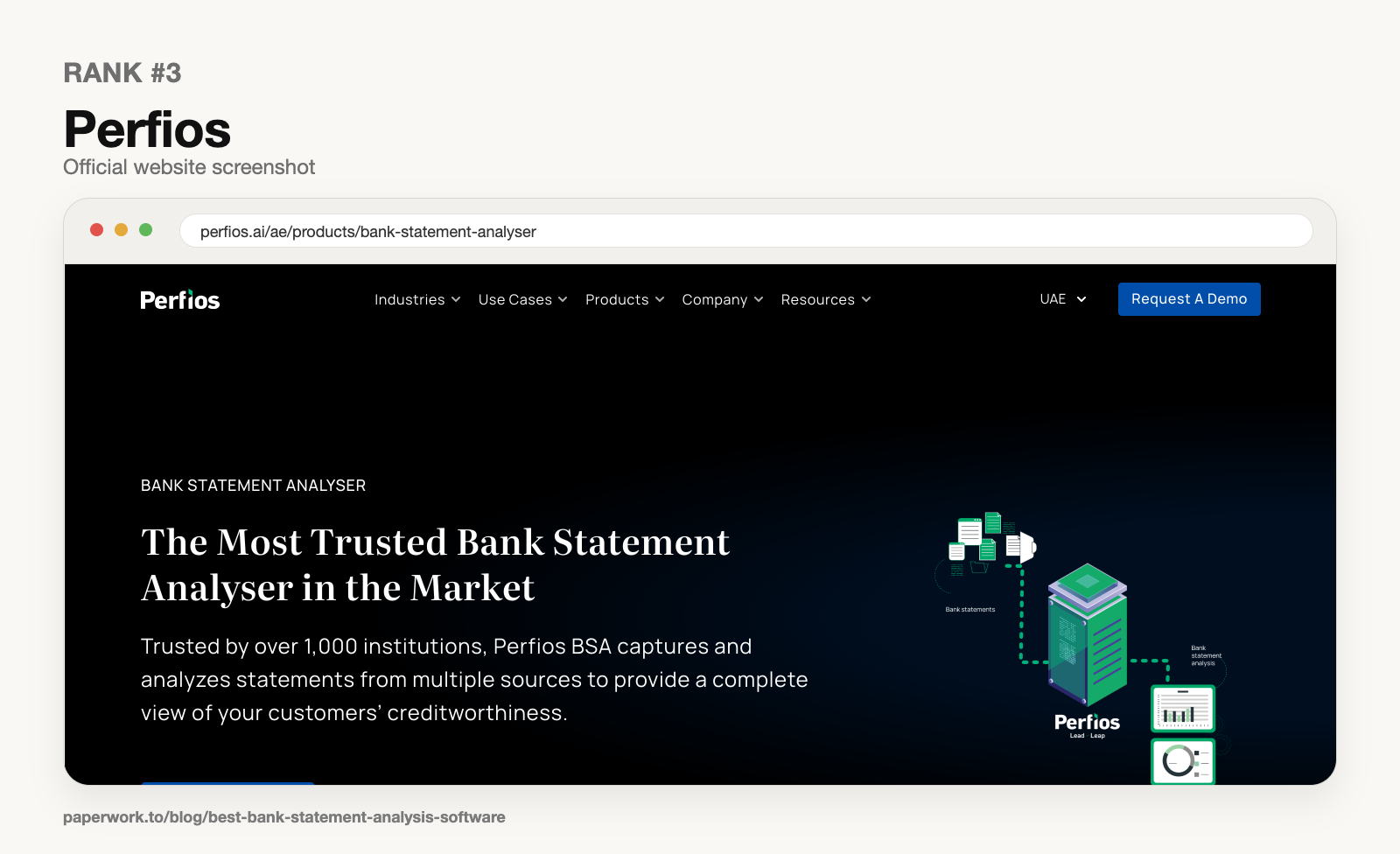
Perfios positions itself as an AI operating system for banks, NBFCs, fintechs and insurers. It started in India and lists offices in Southeast Asia, the UAE, Egypt, Kenya and Ireland.
What it does
The Bank Statement Analyser reads native PDFs, scans and internet-banking downloads, categorises transactions, handles multiple accounts and produces configurable reports on salary, liabilities and more. A built-in fraud check flags possible PDF and transaction manipulation. Perfios says it supports 4,145 native PDF formats and more than 4,000 document formats from over 1,000 banks, in six or more languages, and that it is trusted by over 1,000 institutions.
Strengths
- The widest published bank and format coverage on this list.
- Mature transaction categorisation at very high volume (the vendor cites more than 30 million narrations a day).
- A local presence in several emerging markets, including a UAE product page.
Limitations
- Built for enterprise buyers, with sales-led onboarding and no self-serve tier.
- On-premise deployment is not published.
Pricing
Not published; quote only.
4. Heron Data
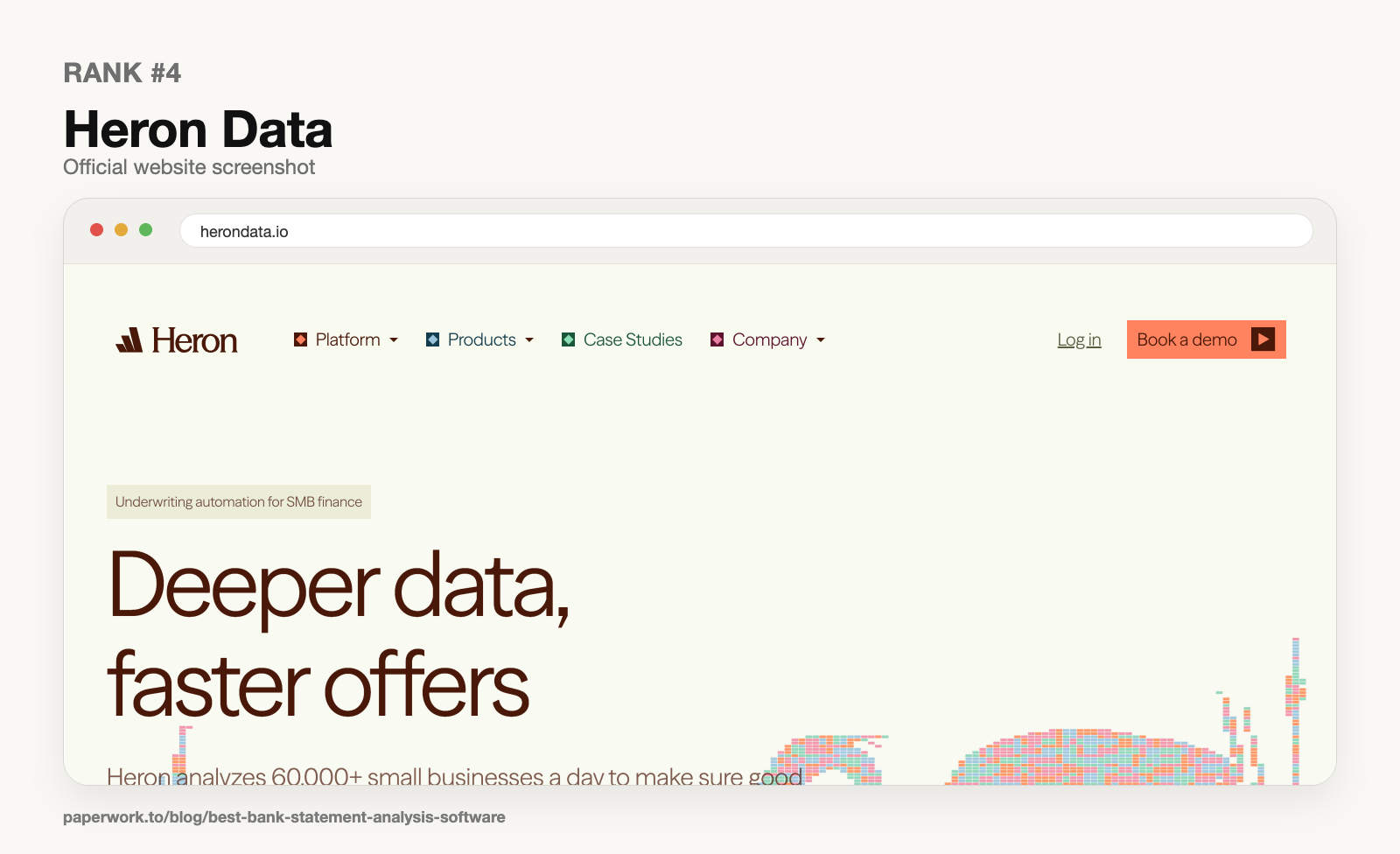
Heron Data sells underwriting automation for small-business finance in the US: MCA, term-loan and SBA funders, brokers and commercial insurers.
What it does
Heron takes applications by email, API or portal, scrubs ISO applications and bank statements, and produces cash flow analytics, including existing funding positions. Its fraud checks look for doctored statements and coordinated fraud across applicants, and it can apply a credit policy and sync results to CRMs such as Salesforce, HubSpot and LendSaaS. The company says it analyses more than 60,000 small businesses a day and raised a $16M Series A led by Insight Partners in July 2025.
Strengths
- End-to-end intake for broker-heavy funding, from email submissions to CRM updates.
- Position tracking for existing MCA advances, which matters for stacking risk.
- Fraud checks that look across applicants, not only within one file.
Limitations
- Focused on US small-business finance; bank and format coverage is not published.
- Cloud only.
Pricing
Not published; demo first.
5. MoneyThumb
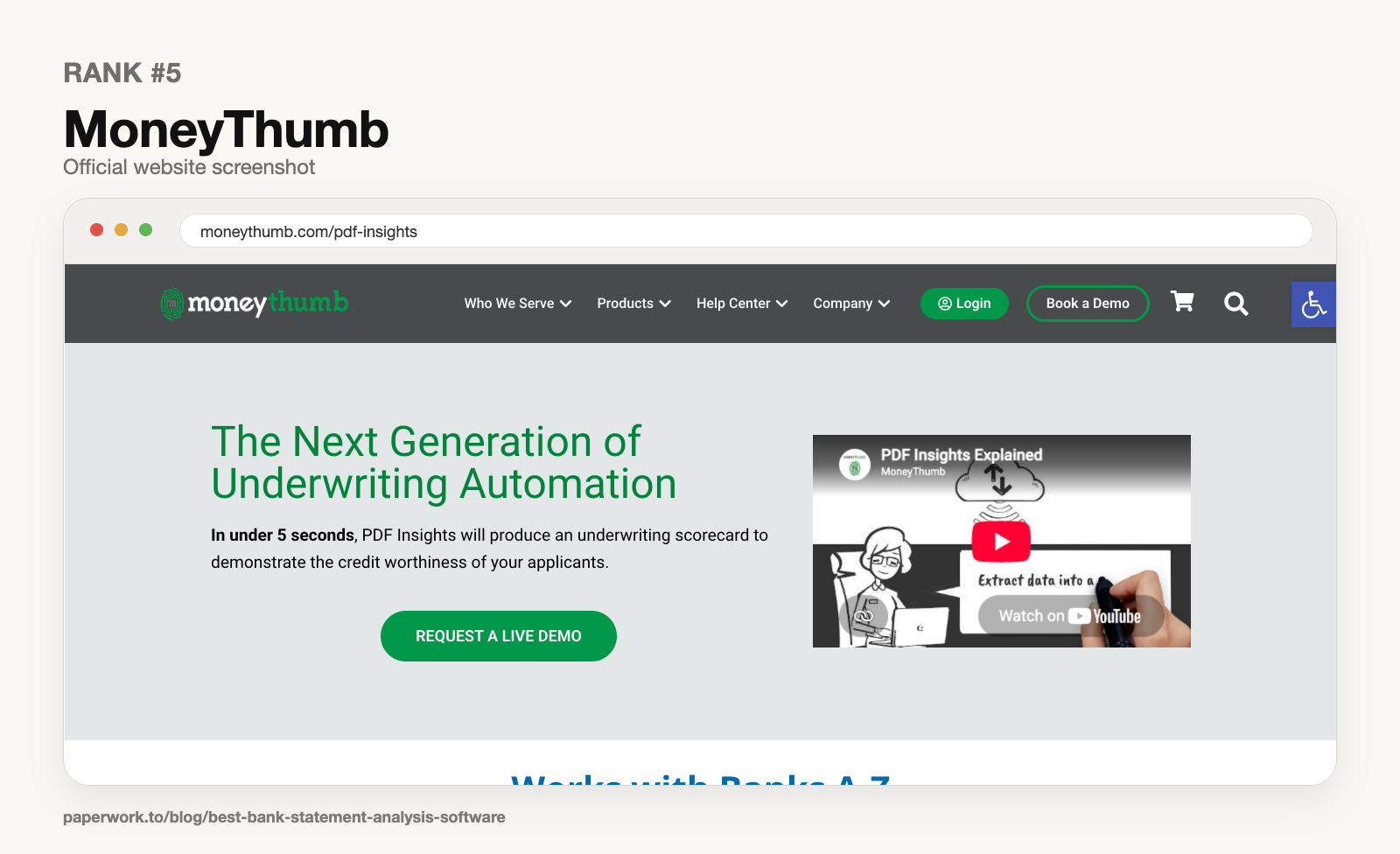
MoneyThumb sells statement conversion and underwriting tools to US funders, small-business and SBA lenders, non-QM mortgage lenders and accountants.
What it does
PDF Insights parses PDFs, scans and images, calculates metrics such as true revenue and negative balance days, and adds a 1 to 100 creditworthiness score, more than 75 transaction categories and an industry check. Its Thumbprint module checks fonts, columns, date formats and totals against a database of financial institutions and returns an authenticity score. Exports include CSV, spreadsheets, QBO and OFX, with an open API. The vendor says it recognises 95% of US bank statements.
Strengths
- Published entry pricing, consumption billing with no monthly minimums, and a free trial on request.
- Underwriting metrics and an authenticity check in the same product.
- Desktop, cloud, API and server options.
Limitations
- Coverage claims are for US banks only.
- Full PDF Insights pricing is not itemised on the pricing page.
Pricing
From $599.95 per year, billed by consumption with volume discounts. See MoneyThumb pricing.
6. FinBox BankConnect
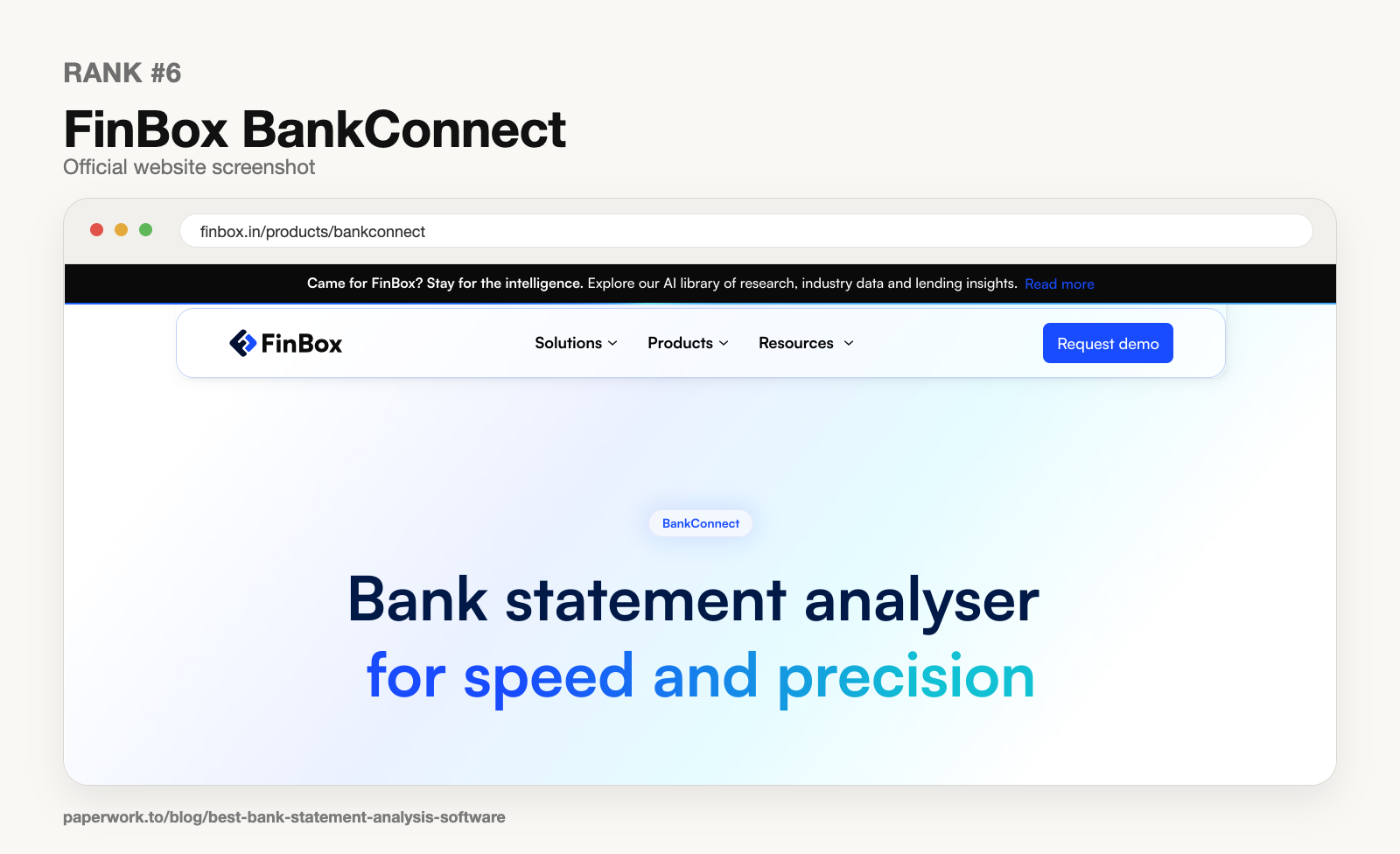
FinBox builds credit infrastructure for Indian banks, NBFCs and fintechs. BankConnect is its bank statement product.
What it does
Borrowers share statements through India's Account Aggregator network, net banking or PDF upload, and BankConnect returns enriched data: income, expenses, obligations, merchants and fraud signals. A bank catalogue API shows which method each bank supports. FinBox raised a $40M Series B in September 2025 to expand beyond India.
Strengths
- Three ingestion routes, including Account Aggregator consent data, which reduces reliance on PDFs.
- REST API and SDKs with separate development and production keys.
- Named lending customers such as IIFL Finance and Muthoot FinCorp ONE.
Limitations
- Built around Indian banks and India's data rails; coverage outside India is not published.
- The current site does not publish a bank or format count.
Pricing
Not published; demo request.
7. Inscribe
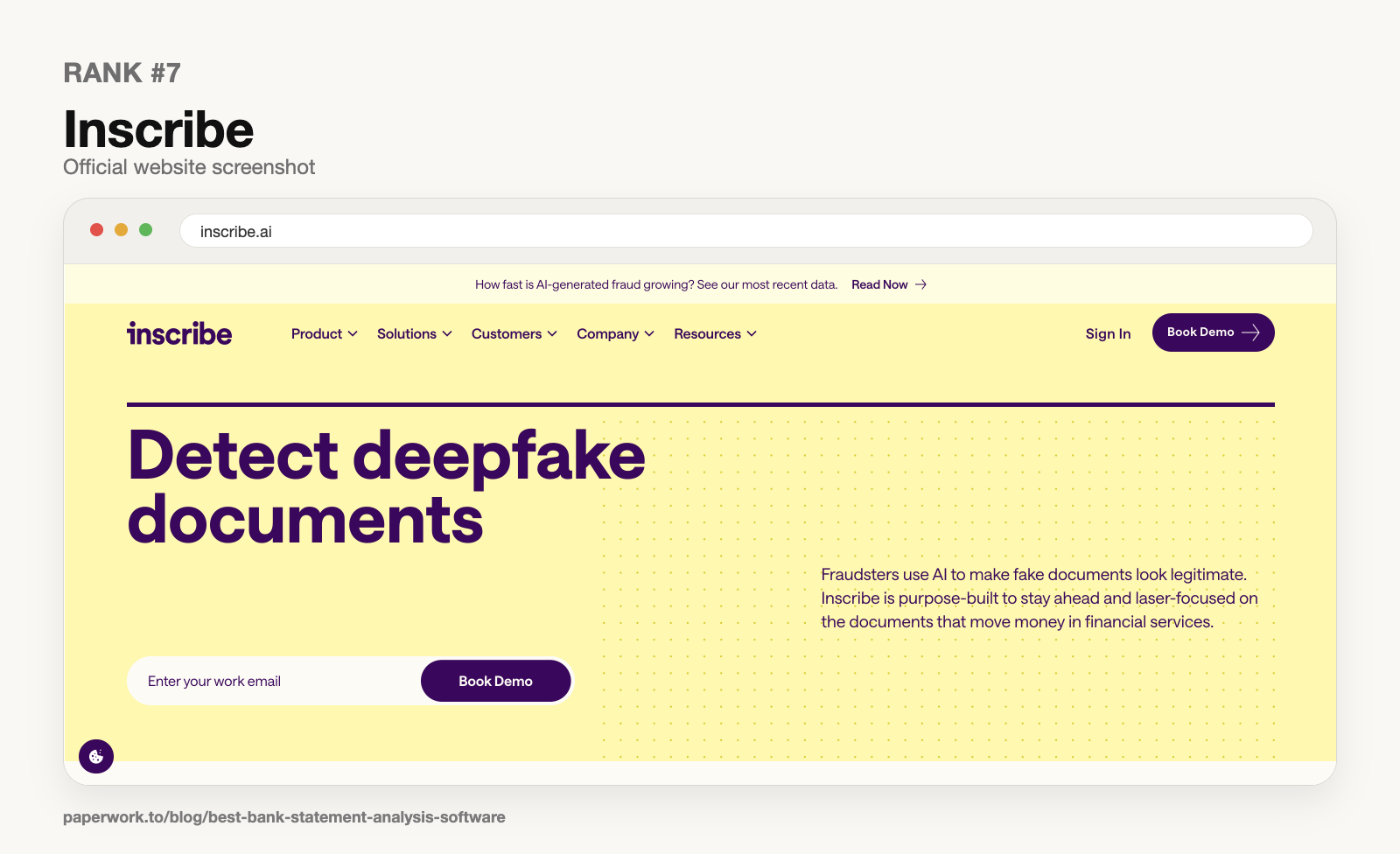
Inscribe is a document fraud detection platform for banks, credit unions, lenders and fintechs, with customers including Plaid, Ramp and Bluevine.
What it does
Inscribe checks statements with pixel-level forensics, metadata inspection, template matching and cross-document consistency, and its AI agents investigate whole applications. The Premium plan adds credit insights and document collection. It is listed here because many teams evaluate it next to statement analysis tools, but it is a fraud and verification layer rather than a full categorisation and cash flow product.
Strengths
- Deep fraud forensics on bank statements, the document type it reports seeing most often in fraud.
- A free four-week pilot.
- Agentic review of full applications.
Limitations
- Full transaction categorisation and cash flow metrics are not described; most teams pair it with an analysis tool.
- Pricing is not public.
Pricing
Not published; based on document volume and features. See Inscribe pricing.
8. Docsumo
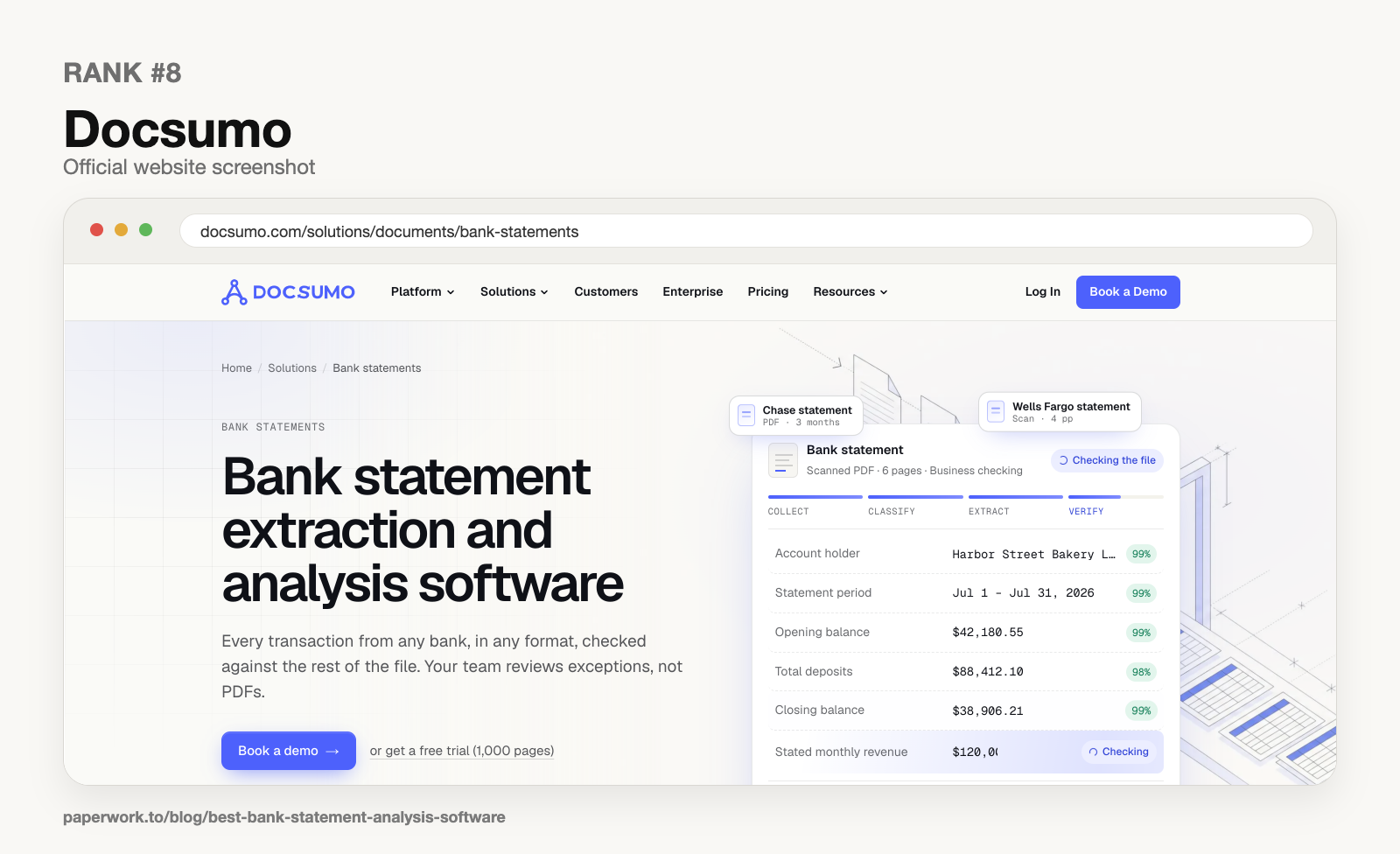
Docsumo is a general document AI platform with solutions for lending, insurance and accounts payable.
What it does
Docsumo extracts every transaction with field confidence scores, assigns categories, reports cash flow, deposit trends and risk flags, and checks for missing pages or months and name or address mismatches. Results go to a review dashboard, JSON via webhook or Excel. The vendor says it handles any bank, digital or scanned, without templates.
Strengths
- A review dashboard with confidence scores for each field.
- Completeness checks for missing pages and months.
- A generous free trial: 14 days and up to 1,000 pages.
Limitations
- A horizontal platform, so lending logic is configured rather than built in.
- Paid plans are quoted and setup fees apply.
Pricing
Free 14-day trial; Business and Enterprise plans are custom quotes based on volume. See Docsumo pricing.
9. DocuClipper
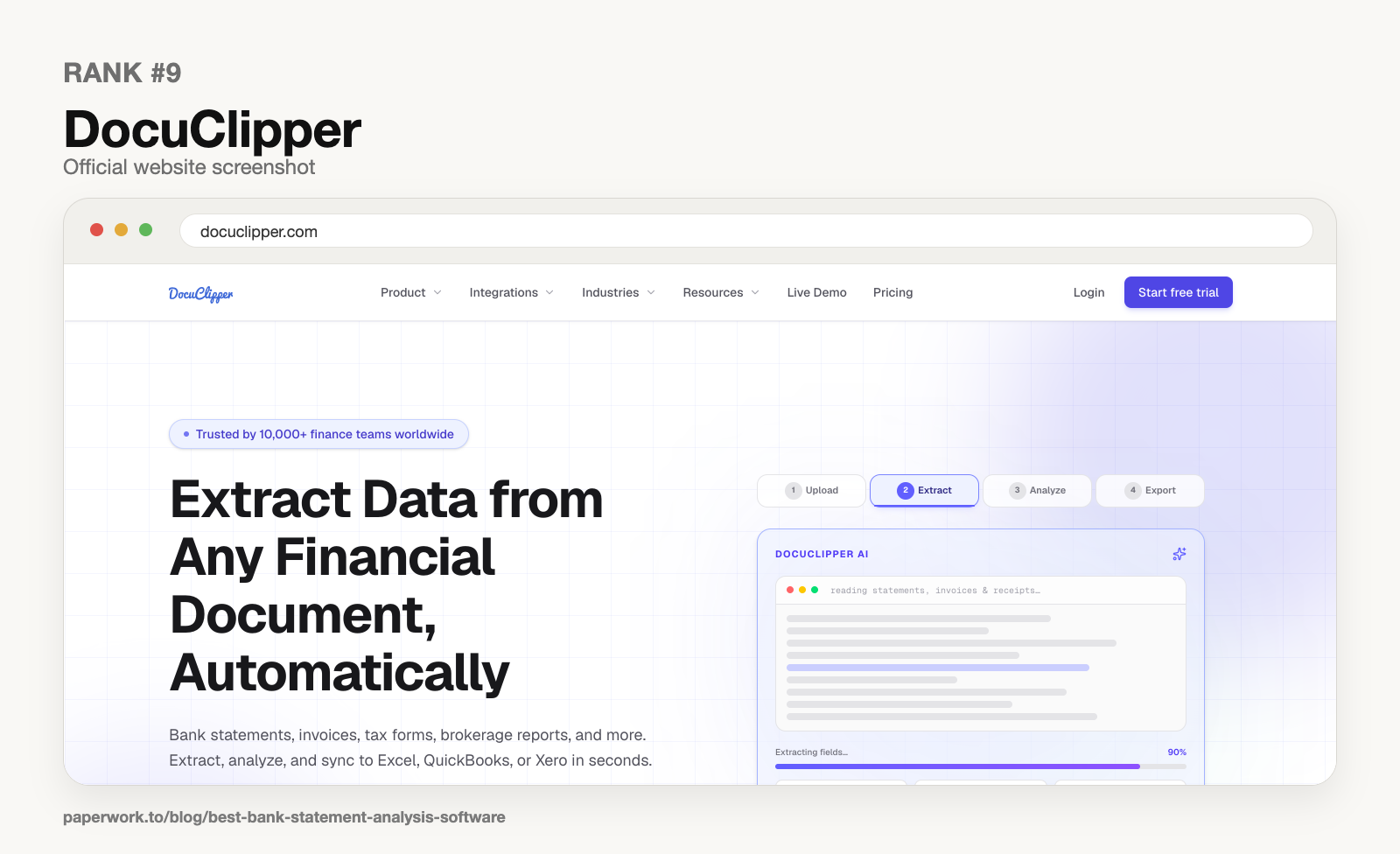
DocuClipper converts bank statements and other financial documents for accountants, bookkeepers and lending firms.
What it does
DocuClipper reads scanned and digital PDFs, reconciles automatically, detects multiple accounts and categorises transactions, then exports to Excel, CSV, QuickBooks or Xero. A REST API with webhooks is available. Cash flow analysis and fraud detection are included from the Business plan up. In 2026 it added coverage for UK, Canadian, Australian and South African banks.
Strengths
- The clearest public pricing on this list, with unlimited users on every plan.
- Fast setup for accounting and bookkeeping work.
- A 14-day free trial with 120 pages and no card required.
Limitations
- Built for conversion and accounting first; lending analytics are a plan feature, not the core product.
- No on-premise option.
Pricing
Starter $20/month for 60 pages, Business $111/month for 640 pages, Enterprise $360/month for 2,000 pages, billed annually. See DocuClipper pricing.
10. Nanonets
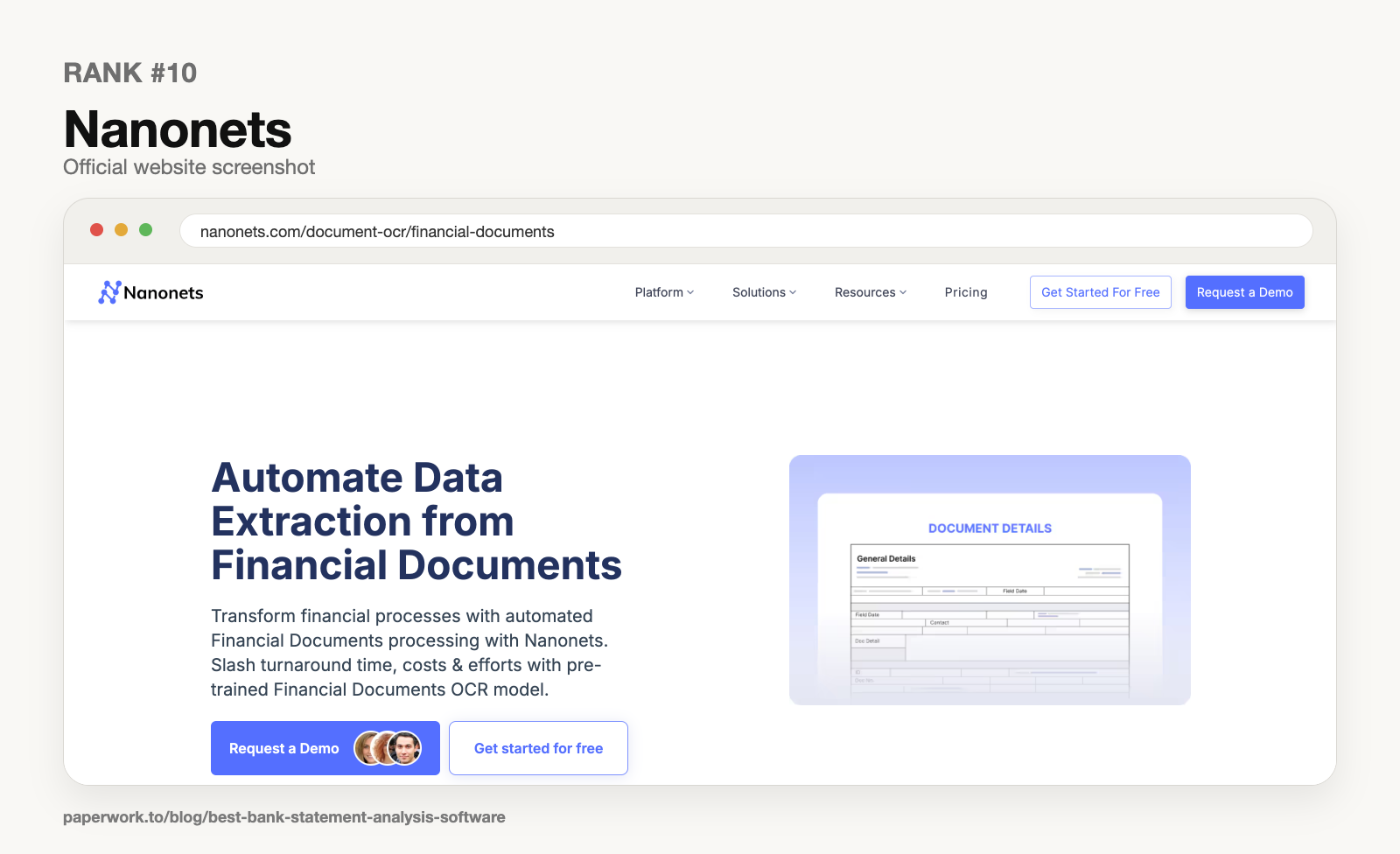
Nanonets is a document workflow platform for invoices, accounts payable, reconciliation and bank statements.
What it does
Nanonets extracts account details and transaction tables, validates them with rules and exports to CSV or Excel or pushes them into ERP and accounting systems. A free online statement converter is available. Lending metrics and statement fraud scoring are not published.
Strengths
- Flexible workflows with validation rules and system integrations.
- Low-cost entry with pay-per-run pricing.
- Private cloud or on-premise deployment on the Enterprise plan.
Limitations
- An extraction and workflow tool; underwriting metrics have to be built on top.
- Bank coverage is not published.
Pricing
$50 in free credits, then from $100/month for 100 credits; Growth and Enterprise are quoted. See Nanonets pricing.
11. Doxis AI.dp (formerly Klippa DocHorizon)
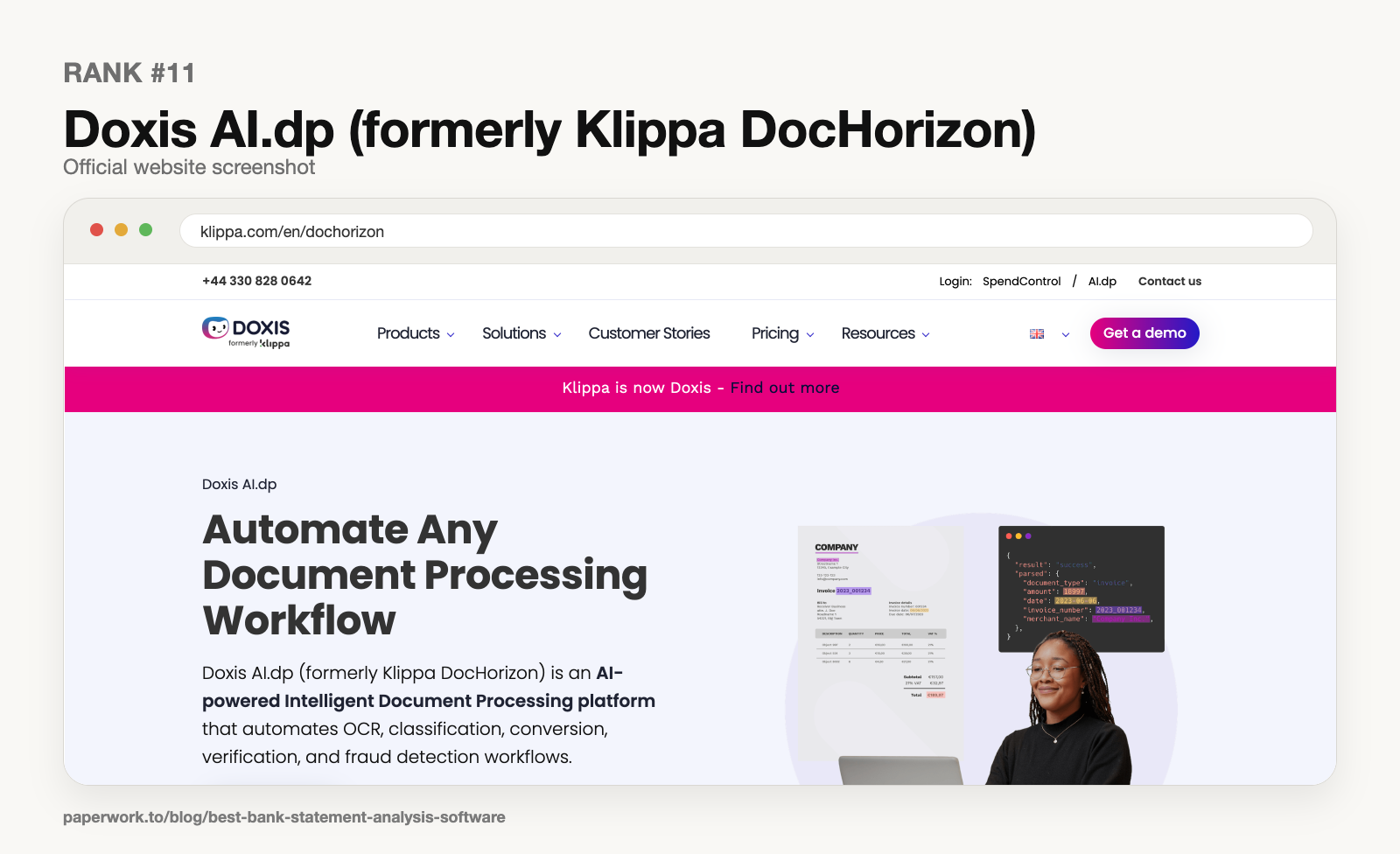
SER Group acquired Klippa in March 2025, and DocHorizon now ships as Doxis AI.dp.
What it does
The platform extracts the account holder, IBAN and BIC, balances and transactions from scans and images and returns JSON, XML, CSV or Excel over an API. Loan, mortgage and proof-of-income processing are listed use cases, and fraud detection is a separate module. The vendor says it supports domestic and international banks in all Latin-script languages.
Strengths
- European document processing vendor with SDKs and a human-in-the-loop module.
- Pay-as-you-go entry with free credits.
- Fraud detection available as an add-on.
Limitations
- Extraction only, with no cash flow underwriting analytics.
- Its own materials note limited support for non-Latin alphabets.
Pricing
EUR 25 in free credits, then pay-as-you-go or an annual license; per-document rates are quoted.
12. Plaid Document Income
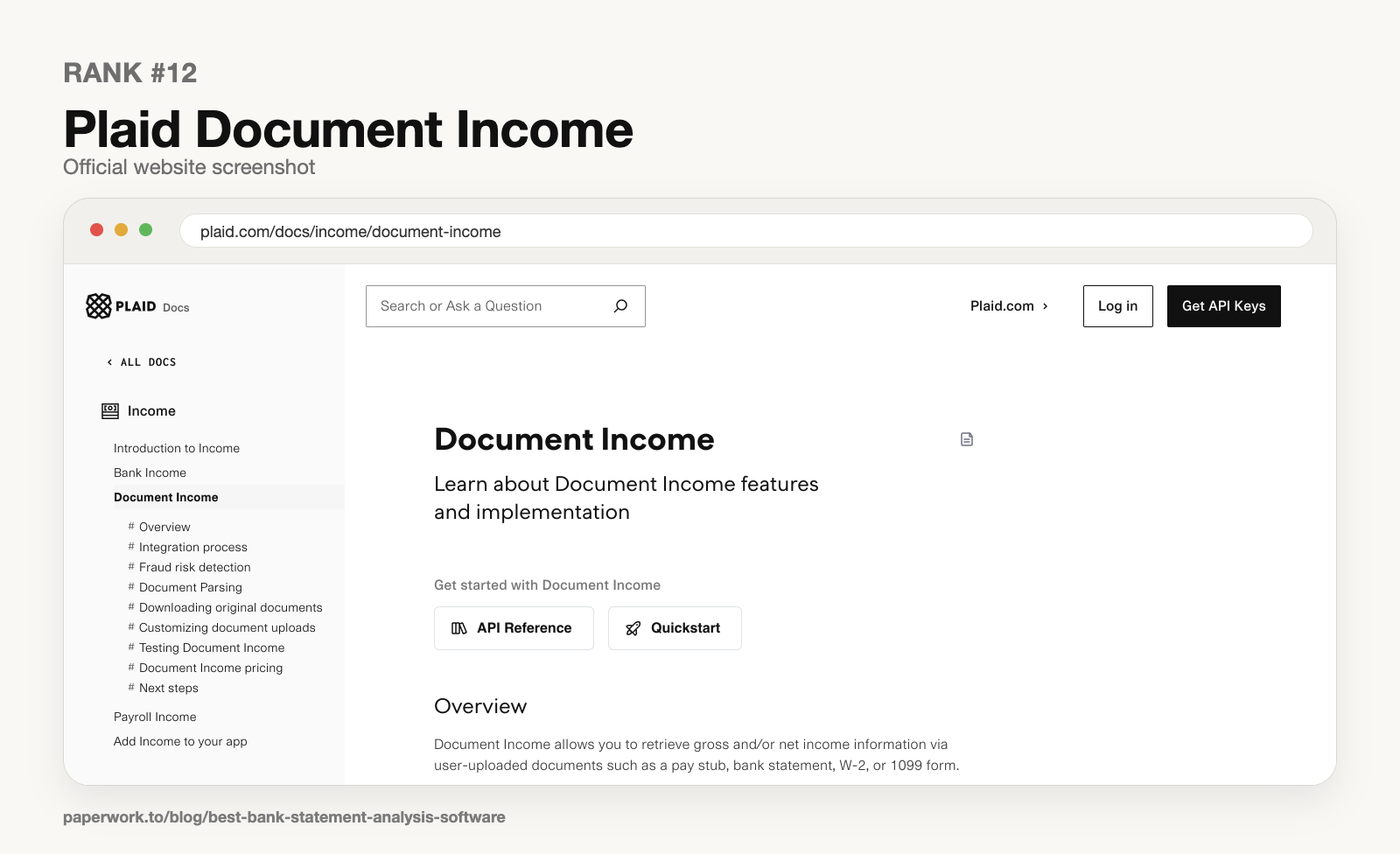
Plaid Document Income is part of Plaid Income, available in the US, Canada and the UK.
What it does
Applicants upload pay stubs, W-2s, 1099s and bank statements, and Plaid returns income data, with optional document parsing into JSON and an optional fraud risk check covering more than two dozen signals. It suits income verification inside an onboarding flow rather than full statement analysis.
Strengths
- Fits teams already using Plaid Link.
- Fraud risk signals on uploaded documents.
- Up to 200 free live API calls per product in limited production.
Limitations
- Plaid's documentation says bank statements are only supported with a custom contract, and recommends a different income product for most new customers.
- No analyst review screen or Excel output for statements.
Pricing
Not published; a one-time fee per document depending on type and options.
Also considered
Several tools touch bank statements without being analysis platforms. Open-banking providers pull transactions directly from the bank with the customer's consent, which avoids PDFs altogether where coverage exists; Lean Technologies and Tarabut are examples in the Gulf, and Plaid and similar networks in the US and Europe. General OCR services from cloud providers extract tables but leave categorisation and metrics to you. In US small-business funding, ClearStaq and other broker tools compete with Heron Data and MoneyThumb.
How to choose for your use case
Start from where your applicants bank and how your credit policy uses the numbers:
- US small-business or MCA funding: Heron Data for broker-heavy intake and CRM sync, Ocrolus for analytics plus fraud on one platform, MoneyThumb if published pricing and consumption billing matter.
- Indian bank, NBFC or digital lender: Perfios for coverage and enterprise reports, FinBox when Account Aggregator data is part of the flow.
- Accountants and bookkeepers converting statements: DocuClipper.
- Teams building their own workflow on a document platform: Docsumo, Nanonets or Doxis AI.dp.
- Fraud as the main concern: Inscribe, alongside an analysis tool.
- Income verification inside a US consumer flow: Plaid.
- Banks, lenders and BNPL providers that need reconciled, explainable metrics, related-party handling and the option to run on their own servers, especially with UAE statements: Paperwork.
Frequently asked questions
What is bank statement analysis software?
Software that reads bank statements, extracts every transaction, classifies it and turns the result into metrics a lender can use: monthly income, average balances, existing debt repayments, returned payments and risk signals. It replaces the manual review of PDFs and spreadsheets in underwriting.
What is the difference between a bank statement converter and an analyzer?
A converter turns a PDF into rows in Excel or CSV. An analyzer goes further: it checks that the rows are complete, classifies transactions, calculates cash flow metrics and flags risks. Accountants often need only a converter; lenders need an analyzer.
How accurate is bank statement analysis software?
Accuracy claims from vendors use different document sets and definitions, so they are not comparable. Test the tools on your own recent statements, including scans and the banks your applicants use, and check whether the tool tells you when it could not read a statement instead of returning partial data.
Can bank statement analysis detect fake statements?
Some tools include fraud signals, such as edited files, totals that do not add up or text pasted over the original. Running-balance reconciliation also catches edits that change an amount without fixing every balance after it. For high-risk lending, pair analysis with a dedicated document fraud check.
How much does bank statement analysis software cost?
Published prices range from about $20 a month for statement conversion to quoted enterprise contracts. Compare the cost of your real workload, including minimum commitments, per-page or per-document rates, setup fees and the analyst time the tool saves.
Is open banking better than analysing PDF statements?
Open banking gives cleaner data where the applicant's bank is connected and the applicant consents. PDFs remain necessary for unconnected banks, older periods, business accounts and markets with limited coverage, so most lenders support both.
Where Paperwork fits
Paperwork's bank statement analysis parses each supported layout with its own parser, reconciles every row, classifies transactions with readable rules and returns 50 monthly metrics and 12 risk checks with the transactions behind them. It runs as a cloud API or under a software license on your own servers.
It sits next to fraud detection, ID reading and company checks on one platform, so a credit team can analyse the statements and check the rest of the application in the same place. For more on reading statements by hand, see bank statement red flags. Try it on your own statements.